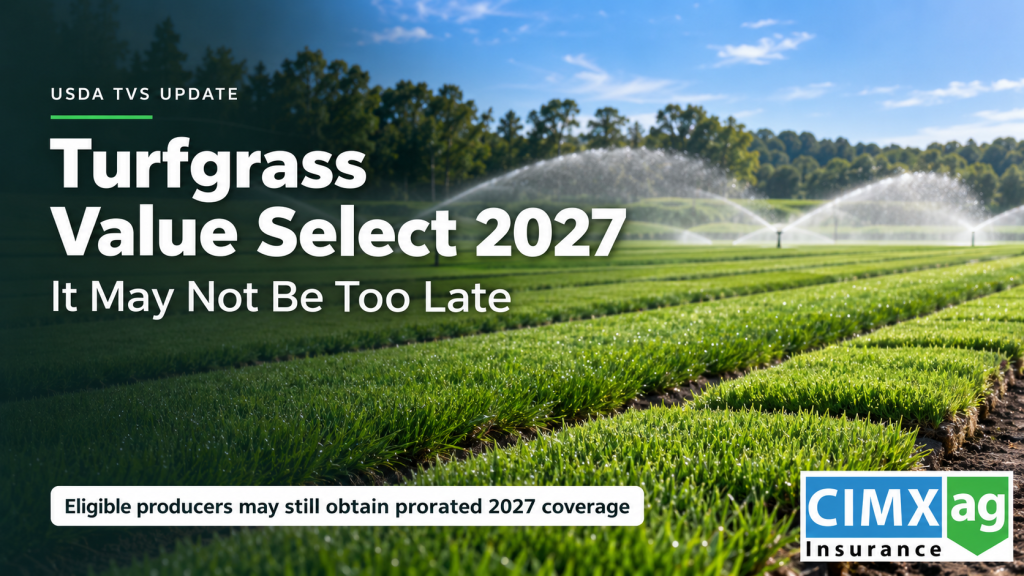
The initial sales closing date has passed, but eligible turfgrass producers may still have an opportunity to obtain coverage for the 2027 crop year.
Turfgrass Value Select is officially underway, and one of the most important things for producers to understand is that September 1 did not completely close the door on coverage.
The September 1, 2026 date was the initial sales closing date for USDA’s new Turfgrass Value Select pilot. However, eligible producers in participating counties can still apply for prorated coverage for the remainder of the 2027 crop year.
That makes this a good time for turfgrass producers who did not enroll before September 1 to take a closer look at the program and, just as importantly, understand some of the details involved in actually putting coverage in place.
Can I Get Turfgrass Value Select Coverage After September 1?
Applying after September 1 does not mean coverage begins the day an application is submitted.
Under the TVS Crop Provisions, a new policy submitted after the sales closing date generally attaches on the 31st day after the insurance provider receives all required documents, assuming the application and documentation are accepted.
The premium is then prorated based on the portion of the crop year remaining.
For a producer considering coverage because of current weather or production concerns, this waiting period matters. Damage that occurs before coverage attaches is not covered.
What Sales Records Are Needed for Turfgrass Value Select?
TVS is built around the value of a producer’s turfgrass inventory, which means documentation plays an important role.
To insure a turfgrass variety, producers generally need verifiable records showing that the variety was sold during at least one of the previous three years. USDA guidance says those records should support information such as the variety sold, quantity, sale price, purchaser and date of sale.
This is an important distinction for operations growing several varieties. Having experience producing turfgrass does not automatically make every variety in the operation insurable.
Before applying, producers should begin gathering sales and inventory records rather than waiting until the application process is underway.
Which Turfgrass Types Qualify?
The current TVS underwriting standards identify seven insurable turfgrass types:
- Bermuda
- Centipede
- St. Augustine
- Zoysia
- Kentucky Bluegrass
- Tall Fescue
- Tall Fescue/Kentucky Bluegrass Mix
The turfgrass must also meet the program’s other insurability requirements, including adequate irrigation. USDA requires sufficient irrigation equipment and water to irrigate the insured turfgrass when coverage attaches and throughout the insurance period.
How Much Turfgrass Value Select Coverage Can Producers Choose?
TVS is different from many traditional crop insurance products because coverage is based on the selected value of the turfgrass inventory rather than simply acreage or historical production.
For additional coverage, producers can choose coverage levels from 50% through 85%, in 5% increments. Producers can also select different coverage levels for different insured turfgrass types.
That flexibility may be particularly useful for operations growing several turfgrass types with different values, markets or risk profiles.
Inventory Can Change During the Year
Turfgrass inventory is not static, and the policy is designed with that in mind.
Producers use a Turfgrass Value Report and Monthly Unit Value Plan to estimate the maximum value of insured turfgrass expected to be on the farm during different months of the crop year.
If inventory grows substantially, the selected value can generally be increased up to twice during the crop year through a revised Turfgrass Value Report. Those increases are also subject to a waiting period before the additional coverage attaches. Once coverage has attached, however, the selected value generally cannot simply be reduced during that crop year.
For businesses where turfgrass inventory rises and falls throughout the year, this makes planning the initial insured value especially important.
What Types of Loss Can TVS Cover?
The policy identifies several causes of loss that may qualify when the damage is unavoidable and occurs during the insurance period. These include:
- Adverse weather conditions
- Fire, subject to policy requirements
- Wildlife
- Earthquake
- Volcanic eruption
Loss of irrigation water may also be covered when it results from an insured cause of loss.
There are also important limitations.
For example, disease and insect damage are generally excluded unless an effective and appropriate control measure does not exist or the Special Provisions provide otherwise. The policy also does not cover a loss caused solely because a buyer refuses to accept turfgrass, a boycott occurs, or certain government restrictions prevent a sale.
In other words, TVS is designed primarily to protect against physical production and inventory losses, not ordinary market or sales risk.
What About the Occurrence Loss Option?
Eligible producers purchasing additional coverage may also have the option to add the Occurrence Loss Option, or OLO.
Standard TVS coverage uses a deductible structure that can make smaller losses less likely to produce an indemnity. OLO is designed to provide additional protection against shallower loss events. Under the current Crop Provisions, an OLO loss generally must reach at least a 10% loss threshold unless the Special Provisions state otherwise.
Whether that additional premium makes sense will depend on the operation, insured value and risk exposure.
What Records Are Needed After a Turfgrass Loss?
TVS producers also have responsibilities when damage occurs.
USDA requires producers to maintain inventory and supporting records, and written consent may be required before damaged turfgrass is destroyed, sold or otherwise disposed of. Claims generally must be submitted within 60 days of the loss, subject to the policy provisions.
That makes accurate inventory tracking valuable both when establishing coverage and if a claim is eventually filed.
Georgia and Florida Producers Should Already Be Looking Ahead
For the 2027 crop year, September 1 was the initial sales closing date across the TVS pilot.
Beginning with the 2028 crop year, however, the schedule changes. Participating counties in Georgia, Florida, Alabama, North Carolina, South Carolina and Texas will have a May 1, 2027 sales closing date.
For Southeastern turfgrass producers, that means the next full-year coverage decision arrives considerably earlier than September.
Questions to Discuss With Your Crop Insurance Agent
Before deciding whether TVS fits your operation, consider asking:
- Is my county currently eligible for TVS?
- Which of my turfgrass varieties meet the sales-record requirements?
- What records should I have ready before applying?
- What selected inventory value makes sense for my operation?
- Should different turfgrass types have different coverage levels?
- When would coverage actually attach if I apply now?
- What would my prorated premium look like?
- Is the Occurrence Loss Option appropriate for my operation?
- Is HIP-WI available in my county?
- What inventory records would I need if a loss occurs?
- What should I do now to prepare for the May 1, 2027 sales closing date?
Turfgrass Value Select FAQ
Can I still get Turfgrass Value Select coverage after September 1, 2026?
Yes. Eligible producers in participating counties may still be able to obtain prorated TVS coverage for the remainder of the 2027 crop year.
When does TVS coverage begin if I apply after September 1?
A new policy submitted after the sales closing date generally attaches on the 31st day after the insurance provider receives all required documents, assuming the application and documentation are accepted.
What turfgrass types qualify for TVS?
The current TVS standards identify Bermuda, Centipede, St. Augustine, Zoysia, Kentucky Bluegrass, Tall Fescue and Tall Fescue/Kentucky Bluegrass Mix.
How much TVS coverage can producers choose?
For additional coverage, producers can select coverage levels from 50% through 85%, in 5% increments.
What records are needed for Turfgrass Value Select?
Producers generally need verifiable records showing that the turfgrass variety being insured was sold during at least one of the previous three years.
When is the 2028 TVS deadline for Georgia and Florida?
Participating counties in Georgia and Florida will have a May 1, 2027 sales closing date for the 2028 crop year.
Bottom Line
The September 1 date has passed, but eligible turfgrass producers may still be able to obtain TVS coverage for the remainder of the 2027 crop year.
The bigger takeaway is that TVS involves more than simply selecting a coverage percentage. Sales history, inventory values, irrigation, documentation, waiting periods and the timing of coverage all play a role.
For turfgrass producers in eligible areas, now is a good time to review the operation with a crop insurance agent and determine whether prorated TVS coverage makes sense for the remainder of this crop year, while also beginning to plan for 2028.